
The Australian construction industry is undergoing a transformative phase, shaped by a combination of government-led initiatives, private sector investments, and evolving challenges. From the rise of sustainable building practices to the adoption of cutting-edge technologies, understanding how the Australian construction industry is changing is essential for anyone involved in the sector.
These changes aren’t happening in isolation. Urban centers like Sydney and Melbourne are redefining how cities are built, focusing on smart infrastructure and connectivity. Meanwhile, rural areas are adopting innovative solutions to overcome logistical and labour challenges, proving that adaptability is at the core of the industry’s evolution. Builders, planners, and stakeholders must keep pace with these developments to remain competitive in an increasingly dynamic environment.
As we explore the key trends and innovations shaping the future of construction, one thing becomes clear: these shifts are not just about building structures—they’re about creating a more sustainable, efficient, and resilient industry. Whether it’s adopting eco-friendly materials, integrating AI-driven technologies, or meeting the demands of urbanization, the industry is rewriting the blueprint for success.
By diving into the details of how the Australian construction industry is changing, we can uncover the strategies and innovations driving these transformations and learn how builders can prepare for what lies ahead.
Sustainability at the Heart of Modern Construction
Shifting Toward Eco-Conscious Practices
In Brisbane, a team of builders adjusts solar panels atop a new commercial building, their tools gleaming under the early morning sun. This moment captures the transformation sweeping across the construction industry. Sustainability is no longer just a trend; it’s a defining feature of how the Australian construction industry is changing, prioritizing energy efficiency and environmental stewardship.
The shift toward eco-conscious practices is driven by necessity and opportunity. Climate change and rising energy costs have made sustainable construction a critical focus for developers, while government incentives and changing consumer preferences have accelerated its adoption. Builders are embracing materials like recycled steel, low-carbon concrete, and sustainably sourced timber, reducing their projects’ environmental footprints while enhancing long-term value.
Take, for example, a Sydney residential project that integrated solar panels and heat-reflective windows. The result? A 30% reduction in energy usage, significantly cutting utility bills for residents. In Melbourne, a high-rise apartment complex achieved a 40% decrease in water consumption by incorporating an advanced recycling system into its design. These are not isolated stories—they reflect a broader industry-wide shift.
Designing for a Greener Future
Beyond materials, sustainability extends to how buildings are designed. Advanced insulation, green roofs, and energy-efficient HVAC systems are now standard, meeting regulations and enhancing liveability. Rural projects are also evolving; in Northern Queensland, a housing development used prefabricated components to cut waste and speed up construction, reducing debris by 50%.
The embrace of sustainability isn’t just about compliance—it’s about staying ahead in an industry that values innovation. Builders and planners prioritizing eco-conscious practices are creating spaces that are future-proof in environmental, economic, and social value. As these practices grow, they highlight how the Australian construction industry is evolving to meet greener future demands.
Smart Cities and Urbanization: Shaping the Future of Australian Construction
Urbanization Driving Smart City Innovation
In Melbourne, a team of engineers works on a cutting-edge traffic system designed to adapt in real-time to congestion. Just a few blocks away, a mixed-use development incorporates energy-efficient street lighting and public Wi-Fi zones. These advancements are just part of how the Australian construction industry is changing, as urbanization drives the evolution of smart cities.
The rapid growth of urban centers like Sydney, Brisbane, and Perth has pushed cities to rethink infrastructure. It’s no longer enough to build spaces; they must be designed to enhance connectivity, efficiency, and sustainability. Smart cities are at the forefront of this change, with projects incorporating intelligent technologies to create environments that adapt to their inhabitants’ needs.
Take Adelaide’s smart precinct, where energy-efficient LED lighting lines the streets, and public spaces are equipped with free Wi-Fi. These features improve quality of life and show how urban spaces balance technology with community needs. In Brisbane, a highway project used sensors to monitor traffic, reducing congestion and emissions.
Reshaping Construction Through Mixed-Use and Modular Developments
Mixed-use developments are another way urbanization is reshaping construction. In Sydney, vertical neighborhoods—high-rise buildings that combine residential, commercial, and recreational spaces—are becoming increasingly common. These projects address housing shortages while reducing urban sprawl, making better use of limited land.
Urbanization also demands innovation in construction methods. Modular construction, for instance, is gaining traction in cities looking to expedite timelines and reduce disruption. By assembling building components off-site, developers can minimize construction times in dense urban areas, where delays can significantly impact costs and schedules.
As cities grow and smart technologies advance, urban design will continue to show how the Australian construction industry is evolving. Smart cities go beyond infrastructure; they create environments that connect people, cut resource use, and prepare communities for future challenges.
Regional Challenges Highlight How the Australian Construction Industry is Evolving
Logistical Hurdles in Remote Construction
In the remote outback of Western Australia, a convoy of trucks winds its way along unpaved roads, carrying prefabricated steel beams to a mining site. The journey is long and arduous, underscoring the logistical hurdles of building in Australia’s rural and regional areas. Yet, it’s in these remote locations that some of the most innovative solutions reveal how the Australian construction industry is evolving.
Regional construction projects face unique challenges, including high transportation costs, labour shortages, and limited infrastructure. Transporting materials to remote locations is costly due to long distances, poor roads, and unpredictable weather. In Northern Queensland, a project used refrigerated trucks to keep concrete from setting prematurely in the tropical heat. This added cost and complexity, but it also highlighted the need for innovative solutions.
Innovative Solutions for Regional Challenges
One such solution is the rise of prefabricated construction. A housing development in Central Australia turned to prefabricated building components to combat delays and reduce waste. By assembling parts off-site and transporting them for final assembly, the project cut construction time by 40% and minimized on-site waste by 50%. For regional builders, prefabrication isn’t just efficient—it’s transformative.
Labour shortages present another significant hurdle. In many rural areas, there simply aren’t enough skilled workers to meet demand. To address this, some contractors have partnered with local trade schools to train apprentices directly on-site. In Central Australia, one project successfully upskilled a dozen local workers, providing much-needed manpower while building a sustainable workforce for future projects.
Overcoming Infrastructure Limitations
Infrastructure limitations also play a role in shaping regional construction practices. Sites far from urban centers often lack access to reliable utilities, requiring creative workarounds. At a mining site in Western Australia, a self-sustaining microgrid combining solar power with battery storage was implemented, ensuring uninterrupted power supply while reducing reliance on diesel generators.
The challenges of regional development are significant, but they also highlight the resilience and adaptability of the industry. By embracing new technologies and innovative practices, builders are not only overcoming obstacles but also driving progress. These efforts demonstrate how the Australian construction industry is evolving to meet the needs of its most remote communities.
Technology: Driving Change in the Australian Construction Industry
Innovative Tools Transforming Construction Sites
On a bustling construction site in Sydney, a project manager reviews the day’s progress using augmented reality glasses, overlaying digital plans onto the physical structure. Nearby, a drone captures aerial footage, sending real-time updates to the team’s project management software. These advancements are more than just tools—they’re at the heart of how the Australian construction industry is changing.
Another groundbreaking innovation is 3D printing, which is gaining traction for its ability to speed up construction while reducing waste. In Perth, a small office building was constructed using 3D-printed walls, slashing the project timeline by nearly 30%. The technology’s precision also minimizes material use, aligning with the industry’s growing focus on sustainability.
The Role of AI and Digital Collaboration
Technology has become a driving force behind the industry’s evolution, enabling builders to work smarter, faster, and more efficiently. One of the most transformative tools is artificial intelligence (AI). In Melbourne, a construction firm used AI to optimize scheduling and cost estimation. By analyzing historical data and real-time inputs, the AI flagged potential delays weeks in advance, helping the company avoid costly overruns and maintain client trust.
Digital platforms like Building Information Modeling (BIM) are further revolutionizing the industry. By providing a centralized system for architects, engineers, and builders, BIM reduces errors and enhances collaboration. Projects that once relied on paper plans now benefit from dynamic, real-time updates, improving efficiency and accuracy.
Drones, once a novelty, are now indispensable on Australian job sites. Their ability to inspect hard-to-reach areas and monitor progress reduces the need for manual checks, saving both time and money. For instance, a Brisbane-based contractor used drones to oversee a highway expansion project, cutting labour costs by $50,000 and identifying potential issues before they escalated.
As these technologies become more accessible, they’re leveling the playing field for smaller firms while enabling larger projects to push the boundaries of what’s possible. They’re not just tools—they’re catalysts for innovation, driving the industry toward a more efficient and sustainable future. Whether it’s AI, drones, or 3D printing, the adoption of these technologies illustrates how the Australian construction industry is changing, making it more resilient and adaptable in the face of new challenges.
Adapting to Change: The Future of Australian Construction
Sustainability as the Foundation for Progress
As the sun sets over a newly completed mixed-use development in Melbourne, the project manager reflects on the journey it took to get there. From planning to execution, every stage of the build required adaptability, innovation, and a forward-thinking approach. This project, like so many others, is a testament to how the Australian construction industry is adapting to an ever-changing landscape.
One of the most significant ways the industry is evolving is through its focus on sustainability. Builders are no longer just creating spaces; they’re crafting environments that prioritize energy efficiency and reduce environmental impact. Projects that incorporate solar panels, recycled materials, and advanced insulation techniques are setting new benchmarks for eco-conscious construction. These changes are not only meeting current regulatory demands but also preparing the industry for future environmental standards.
Technology is another cornerstone of adaptation. The integration of AI, drones, and 3D printing has streamlined workflows, reduced errors, and improved efficiency. For example, a Sydney developer recently leveraged Building Information Modeling (BIM) to coordinate a high-rise project, reducing delays by 20% and saving millions in potential overruns. These tools are no longer luxuries—they’re necessities for any firm looking to remain competitive.
Innovations in Rural and Regional Construction
In rural and regional areas, the story of adaptation is even more profound. Because of limited access to resources and skilled labour, builders have been forced to innovate in ways that urban projects rarely require. For instance, prefabrication and modular construction effectively tackle logistical challenges. Moreover, local collaborations help address labour gaps and build sustainable workforces. In Western Australia, a mining project used a solar-powered microgrid, proving remote builds can succeed with innovative solutions.
At the heart of these changes is a shift in mindset. Builders, planners, and developers are increasingly viewing adaptability not as a response to challenges, but as an opportunity to lead. By embracing sustainability, leveraging technology, and rethinking traditional practices, they’re setting the stage for a construction industry that’s more resilient, efficient, and future-focused.
In Australia, the construction industry drives economic growth, builds communities, creates opportunities, and reflects the nation’s values. Its ability to adapt will determine how it meets future demands. This adaptability ensures the industry remains a pillar of progress for years to come.
Building a Resilient Future for Australian Construction
The Australian construction industry stands at a pivotal moment, driven by innovation, sustainability, and adaptability. From smart cities to remote prefabrication, the industry adopts new methods to tackle a changing world. These advancements are not just shaping skylines but also redefining the values of efficiency, environmental stewardship, and community impact.
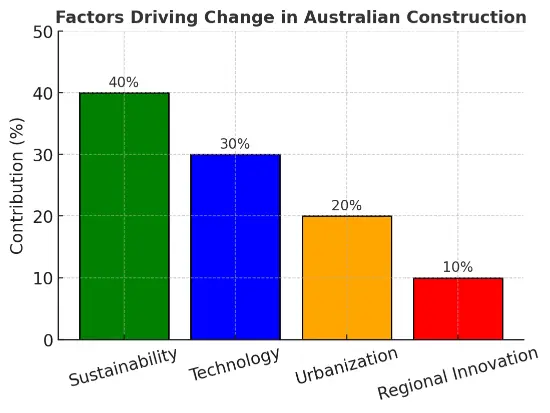
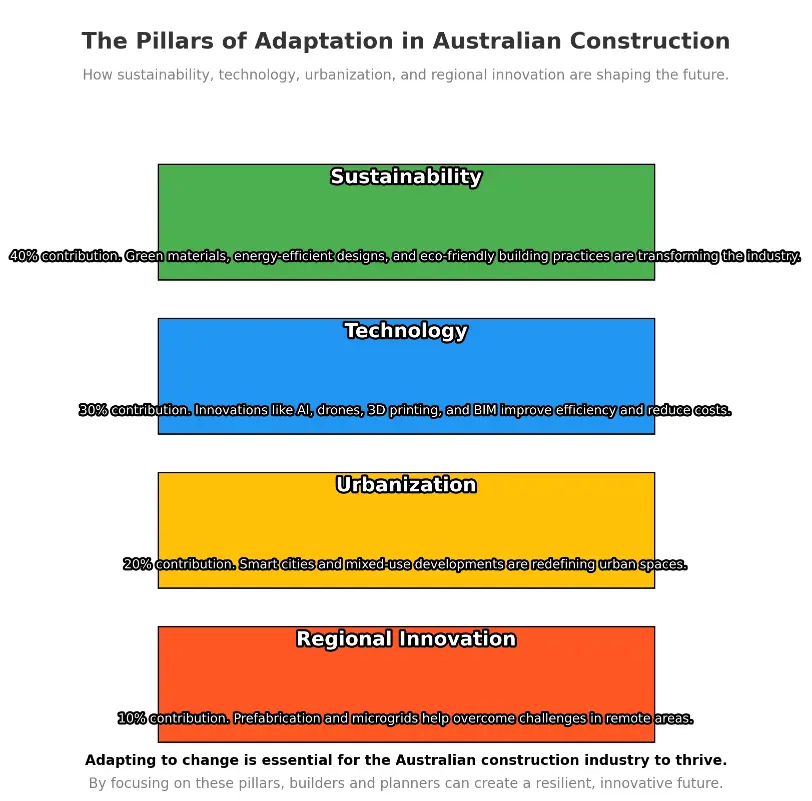
At the heart of this transformation are the four pillars: sustainability, technology, urbanization, and regional innovation. These elements show how the Australian construction industry adapts to meet current demands and prepare for the future.
The ability to innovate, collaborate, and overcome challenges keeps Australian builders and planners leading the global industry. As the industry evolves, it creates opportunities, strengthens communities, and builds a sustainable future.